Cosmology
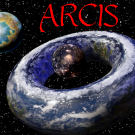
The world of Arcis is, like earth, a large corporeal object of matter adrift in a kind of void, with many recognizable characteristics (weather, oceans, continents, civilizations anthropomorphic peoples etc.) However, the details beyond that diverge greatly from the traditional concepts of a universe. The "planet" itself is toroidal, as opposed to spherical, and has two moons: Belmea and Solstea. The void in which it drifts bears enough visual similarity to the universe of earth so as to be mistaken for it at first glance, but in actuality is divergent in enough ways so as to be substantially different.

The Torus

The world of Arcis is shaped like a Torus with an outer circumference of nearly 30,000 miles. The space in the center of the Torus is commonly known as the Annulus.
The Moons
Arcis is orbited by two moons, each with their own orbital patterns and cultural, historical, and religious significance. Since atmospheric conditions are fundamentally different on Arcis than they are on Earth, the Moons are theoretically traversable and inhabitable, as evidenced by examples such as The Orphic Veil.
Solstea
See also: Solstea
Arcis' more stably orbiting moon, Solstea maintains an even orbit around the outer circumference of Arcis, and therefore plays a much bigger role in measuring time and creating calendars than her counterpart Belmea. Early in recorded history the Thri-Kreen began to worship Solstea as a deity and therefore gave rise her to sentience and power (see Divinity).
Belmea
See also: Belmea
In contrast with Solstea, Belmea's orbit around Arcis is irregular and chaotic. Though the subject of study by many scholars, no mathematical pattern to it's movement has yet been proven. However, methods of divination have proven capable of predicting certain movements of Belmea a short time before they happen. On very rare occasions this moon will pass through the Annulus. This event occurs less than once a century and is met with very important celebratory rituals in many cultures, including the Kinisi celebration of southern Thalindor. It has been noted that during this event several other prominent celestial phenomena occur, such as runic illumination of the stars, hyperactivity of the paranormal sight in Runegazers, and strange shifting patterns on the moon.
The Sun and Stars
Technically speaking there are no sun or stars on Arcis. Instead the stars and daylight are visual phenomena that occur to observers on the Torus caused by a field of magical energy that envelops it. This magical field concentrates light in various intensities: when dim, it resembles Earth's stars, and when bright, it mimics daylight without forming a distinct, blinding sun-like object. The residents of Arcis use this phenomenon as their day-night cycle.
Divinity
The deities of Arcis are real living beings, but not strictly corporeal in the same was as mortals (non-divine beings). Additionally, while they enjoy a heightened level of influence on the aspects of reality which fall under their Domain, they are subject in a way to mortal belief. A deities existence is reliant on a quorum of consensus belief, and their level of power determined by a continuum of strength within that consensus. Thusly, the more followers and more strongly held those followers beliefs are held, the more power and influence a deity wields.
This divine nature gives rise to several interesting mechanics of divinity itself. Firstly is that deities are "born" in a Realm which is a distinct and separately contained reality than that of Arcis' mortal inhabitants, and a given deities Realm reflects that deities nature.
Secondly, because a deity's power is finite and reliant on faith, they must carefully choose how to influence the Mortal Realm —usually acting through a mortal conduit. While a direct presence or direct intervention is possible, it would significantly deplete their power.
Lastly, once a deity is "born" it is exceedingly difficult for it to "die". If a deities faith wanes enough, it's power will dwindle and it will fall into a kind of slumber, it's realm slowly crumbling around it. However, as long as its name remains in one memory or scribed in one text it will continue to exists with the potential for future revival through renewed faith.
Magic
Magic is inherit and endemic to all aspects of the world of Arcis. It is the underlying force that gives rise to matter and the spark of life. In many ways it is the most foundational aspect of all existence. The Torus of Arcis itself was formed from the magical emissions of a field of magical energy within a void. This field now surrounds the Torus and is perceived by the inhabitants as daylight and starlight as it progresses through a persistent oscillation of luminescence.
This force, known as magic, is accessible and functional through a number of methods and its outcomes and effects vary depending on the method used to access it. Divine Magic is accessed through a connection with a deity, where the deity is channeling the magic at its disposal to the mortal being that beseeches it. Primal Magic is magic that is accessed from the voluminous reserves of magic stored in the natural world (i.e. trees, oceans, wind, the Torus etc.). Arcane Magic is channeled directly from the field surrounding the Torus in its most raw and malleable form. Other, less prominent means of accessing magical force exist and are numerous but these three are the most common.
Realms
In the cosmology of Arcis, realms are distinct layers of reality, each existing independently of the others. The primary narrative unfolds within the Mortal Realm, which serves as the central stage for most events. Deities inhabit their own Divine Realms, while other planes, such as the enigmatic Fey Realm, exist with varying degrees of accessibility and influence.
Realms are fundamentally discrete, and travel between them is not possible by ordinary means. Only exceptionally powerful forms of magic—typically the domain of deities or other cosmic forces—can bridge these divides.
The Fey Realm
The Fey Realm is the only known exception to the otherwise rigid separation between realms. Prior to the Fey War (Circa 900 IE), a gate to the Fey Realm was opened in the region of Arin'silath, an event that directly triggered the conflict between the Fey and the peoples of Arcis. This rupture weakened the barriers between the Fey Realm and the Mortal Realm, resulting in unstable and intermittent connections that continue to form and collapse unpredictably.
Sometime around 2100 IE The Silver Reach Empire began establishing permanent and stable gateways into the Fae Realm within their metropolitan areas. Since this time the interchange between the Fae Realm and the Mortal Realm has become more commonplace.
Ontology
The peoples of Arcis have limited knowledge of the details provided above. As history progresses they become more knowledgeable, but even the discovery of the Torus shape of Arcis did not happen until the invention of airships during the Age of Empires. As of the end of the Toric War knowledge of the true nature of Divinity, Magic, and Realms is still very limited and esoteric.